
Medical and Radiation Imaging
Medical and Radiation Imaging
Medical and radiation imaging increasingly rely on advanced sensor technologies to achieve higher precision, efficiency, and spectral sensitivity.
Our group develops both hybrid and monolithic detectors based on silicon and CZT sensors tailored for X-ray and radiation imaging applications. In hybrid architectures, we focus on energy-resolved (color) imaging through photon counting and on-chip energy clustering across multiple energy bins.
For large-area applications, we design detectors with high total ionizing dose (TID) tolerance for reliable performance in harsh radiation environments.
We also contribute to the development of ultrafast X-ray cameras for diagnostics in plasma physics experiments.
 Ing. Radek Novotný, Ph.D.
radek.novotny@fjfi.cvut.cz
 Ing. Lukáš Tomášek
lukas.tomasek@fjfi.cvut.cz
Medical Imaging
We focus on developing custom ASIC-based detectors for advanced medical imaging and radiotherapy, combining sensor innovation with close industrial and pre-clinical collaboration. The work centers on adapting high-energy physics technologies to healthcare, emphasizing practical performance, radiation tolerance, and integration into real-world systems.
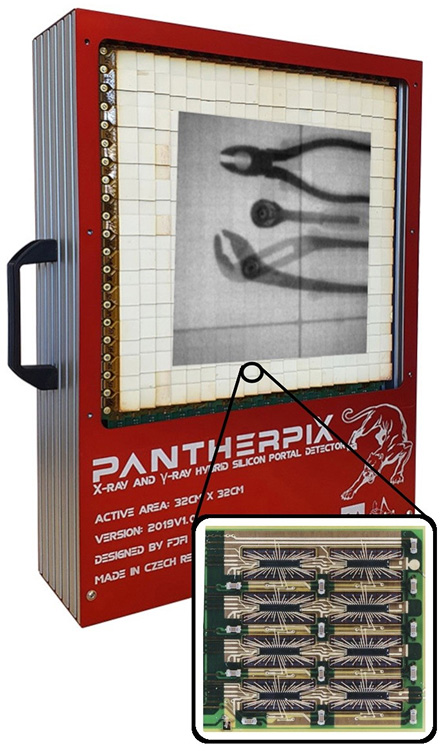
One key project, PantherPix, is a large-area hybrid pixel detector designed for radiotherapy quality assurance and portal imaging. Its architecture prioritizes robustness and linear dose response over fine resolution, making it ideal for verifying patient alignment and dose distribution across clinical photon beams, including older cobalt-60 sources. Tests have confirmed its stability under high-dose conditions, showing potential for long-term clinical deployment.

Another major effort is ColorPix, a photon-counting ASIC technology aimed at spectral X-ray imaging for computed tomography (CT). Unlike traditional detectors, ColorPix measures the energy of individual X-ray photons by binning approach, enabling material-specific imaging ("color CT"). By integrating fast readout and on-chip charge clustering, this system supports high-resolution, multi-energy imaging that enhances contrast and material discrimination.
KEY TASKS
Design and Simulation of Sensors and Readout Electronics: we develop custom ASICs and sensor systems tailored for medical applications such as radiotherapy dosimetry and spectral CT. This includes front-end design, energy discrimination, and fast data acquisition architectures optimized through simulation.
System Testing, Calibration, and Experimental Verification: our detectors are validated in realistic clinical settings using medical photon and X-ray sources. We perform energy calibration, dose linearity checks, and long-term radiation tolerance studies to ensure reliable operation in hospitals.
Monitoring and Protection
We also design and develop advanced radiation imaging detectors tailored for scientific and industrial use, focusing primarily on monolithic pixel sensors. These devices combine theradiation-sensitive area and readout electronics on the same silicon chip, offering high resolution, compact form factor, and cost-effective production.
Key developments include the X-CHIP series, monolithic CMOS imagers optimized for soft Xray spectroscopic imaging. These chips integrate pixel-level charge amplification and digitization, enabling simultaneous imaging and energy measurement of X-ray photons. Tested in labs, accelerators, and space-like environments, X-CHIP devices are suitable for applications like fluorescence mapping, small-scale tomography, or elemental analysis.
Another highlight is FasXcam, a fast X-ray camera system designed for plasma diagnostics in fusion research. It captures rapid X-ray dynamics at frame rates up to 10kHz, enabling timeresolved imaging of fast processes like plasma instabilities or bremsstrahlung emission. Built to withstand high radiation flux and electromagnetic interference, FasXcam is co-developed with plasma institutes to meet the specific demands of real-time, high-speed diagnostics in extreme conditions.
KEY TASKS
Design and Simulation of Monolithic Detectors and ASICs: we design monolithic CMOS sensors for X-ray and charged particle detection with integrated readout and digitization. These are optimized for high frame rates, energy resolution, and operation in harsh environments.
Testing, Calibration, and Experimental Deployment: the systems are extensively tested using radioactive sources, beamlines, and plasma devices. We calibrate their spectral response, assess radiation hardness, and validate performance in applications like plasma diagnostics and elemental mapping.
Meet Our Imaging Team
